

Meditation can help you relax, ease feelings of anxiety and become more present, while giving you a way to practise focusing your attention. It involves bringing your attention deliberately to something such as your breathing, a sound, a guided voice or what you notice in the present moment. It takes many forms, with roots in spiritual and religious traditions as well as a place in everyday wellbeing. You might practise in silence, follow a recording or bring that awareness to a walk.
What it means to people varies too. For some, meditation is a way to connect with themselves spiritually. Others turn to it for a calmer moment in a stressful day, a chance to understand their feelings or a little time away from constant demands. Your reasons can change as the practice becomes more familiar.
That time can feel particularly valuable when there is always something asking for your attention. A message to answer, a problem to solve, another notification on your phone. Even a quiet moment can quickly fill with thoughts about what needs doing next.
At Gal Pal, we see meditation as an opportunity to pause and pay attention to yourself. You do not need to arrive feeling peaceful or know exactly what you hope to get from it. Curiosity is enough to begin.
You do not have to stop thinking
One of the most discouraging ideas about meditation is that you should be able to empty your mind. You sit down, thoughts arrive, and you conclude that you must be doing it wrong. Perhaps you assume that calm people can meditate and you simply are not one of them.
Thoughts are part of the experience. You might remember an appointment, become distracted by a sound or start planning dinner. Noticing that you have wandered and bringing your attention back is something you can practise. You do not need to criticise yourself each time it happens - it’s just a part of it!
Your point of focus might be the feeling of breathing, the sounds around you or the words of a guided recording. When you notice your attention moving away, you return to that point. Some days you will do this often, other days it will be less - the practice is still worthwhile either way.
This changes the expectation you bring to a session. You are making time to observe your experience, rather than taking an exam in concentration. There is no need to emerge with a perfectly clear mind or a dramatic insight. Finishing with a little more awareness of how you feel is a reasonable place to begin.
A pause before the next reaction
There are moments when the speed of a response seems to decide everything. A message annoys you, and you immediately want to explain why. A problem appears at work, and your mind begins building a much bigger problem around it. You notice yourself getting tense, but keep going because there is so much to do.
Meditation can give you a regular opportunity to become familiar with those reactions. How does tension feel? What happens to your attention when you are worried? Do you start moving quickly, checking repeatedly or imagining conversations that have not happened?
Recognising a feeling does not mean it disappears. It gives you a chance to consider what you need before you respond. You might still need to address the message or solve the problem. You may also find that you can do it after taking a moment, rather than while every thought is demanding to be acted on immediately.
Our founder, Fiona, often turns to meditation during stressful days. Taking ten or twenty minutes with a guided recording is something she finds calming and helpful for returning her attention to the present.
What we know about the benefits of meditation
Research on meditation includes very different practices, from short recordings to structured programmes taught over several weeks. The benefits of meditation depend partly on what is being practised and the circumstances of the person doing it.
The US National Center for Complementary and Integrative Health reports evidence that some mindfulness-based approaches may help with symptoms of anxiety and depression, and may improve sleep. Research quality varies, and findings about a structured programme should not be treated as a guarantee about a particular app or a few minutes of practice.
For an everyday practice, you can pay attention to your own experience. Do you feel more able to concentrate afterwards? Does it help you settle before bed? Do you notice tension earlier, or become more aware of when you need a break? Those observations can help you decide how meditation fits into your life.
There is no need to make a sweeping promise about changing your brain or transforming your health to find value in a quiet moment. If it helps you step away from a busy day and return feeling more present, that matters in its own right.
When rest becomes another thing to get right
It is possible to turn almost any helpful habit into another standard to measure ourselves against. You intended to meditate every morning. You missed two days. Now the app's reminder feels like evidence that you are failing at looking after yourself.
Consider what you hoped the practice would give you. If the answer was a little more peace, it is worth noticing when the rules around it start producing the opposite. A routine should help you make room for something useful. It does not need to become a test of your character.
For women who are already accustomed to keeping track of other people's needs, being told to develop an elaborate wellbeing routine can feel like being handed more work. There is a difference between offering someone an opportunity to pause and making them responsible for being perfectly calm in difficult circumstances.
You can meditate and still object to an unreasonable workload. You can take a breath and still ask someone to do their share. Looking after yourself includes responding to the conditions of your life, as well as considering how you feel within them.
Finding a voice you want to listen to
Guided meditation can be a welcoming starting point because someone talks you through the practice. You have something to return to when your attention wanders, and you do not have to work out every detail yourself.
The voice matters. A recording that one person loves may irritate another. You might prefer a teacher who speaks gently and leaves plenty of silence, or one who explains what they are asking you to do. Some recordings include spiritual language, music or imagery. Others keep the focus on breathing and immediate sensations.
Fiona uses Insight Timer and particularly enjoys recordings by davidji. Listening to his voice helps her settle into the practice. You can try a teacher's shorter recordings before deciding whether you would like to spend more time with them.
Give yourself permission to choose. If the music distracts you, try a recording without it. If the language feels awkward, find another teacher. The aim is to find a practice you want to return to, rather than persuade yourself to enjoy something because it is popular.
Beginning without making a production of it
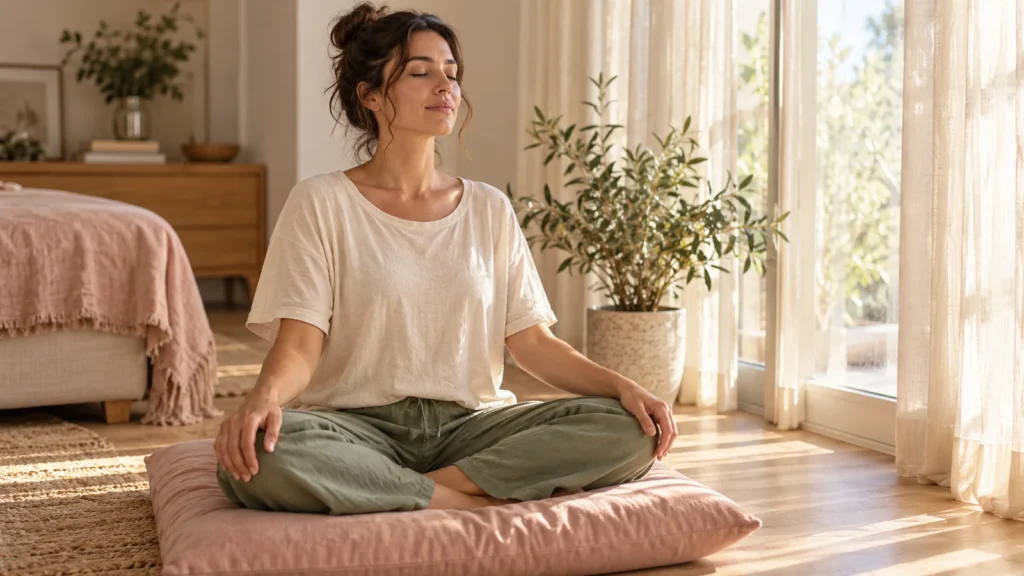
Choose somewhere you can be reasonably comfortable for a few minutes. You do not need a special room or a particular posture. Sitting in a chair is fine. Let your body be supported and allow your breathing to stay natural.
You might begin by noticing the contact between your body and the chair, or the feeling of your feet on the floor. Then bring your attention to a breath. You do not have to change it into a very deep breath or make it last a particular length of time. Simply notice it.
When your mind goes elsewhere, come back when you notice. If you are using a guided recording, let the teacher's instructions give you a structure. Keeping your eyes open is an option if that feels more comfortable.
A few minutes can be a sensible introduction. Finishing a short session that felt manageable may make it easier to practise again than forcing yourself through a long one you dread repeating. As you become more familiar with it, you can decide whether you want more time.
You may also prefer movement. Walking slowly and paying attention to what you can see, hear and feel can offer a different way to practise awareness. Choose a safe route, stay aware of your surroundings and let the experience be simple.
Making room for difficult days
Meditation does not always feel relaxing. Sitting quietly can bring uncomfortable thoughts or feelings closer to your attention. If a practice makes you feel more distressed, you can stop, open your eyes, move or choose something else. You do not need to push through distress to prove that you are committed.
If difficult reactions recur, discuss them with a qualified teacher or a healthcare professional. Meditation can sit alongside other forms of support; it should not replace care you need. The NCCIH also notes that adverse experiences can occur, even though meditation is often presented as universally gentle.
On an ordinary restless day, you might simply need a different kind of pause. A walk, a stretch or a conversation may suit you better. Being attentive to yourself includes recognising when the thing you planned is not the thing you need.
That flexibility can make a practice easier to keep. You are allowed to respond to the day you are having, rather than perform the routine you imagined when everything felt straightforward.
A little more space in the day
One reason meditation appeals to us is that it makes time for attention without requiring an immediate outcome. So much of life asks us to produce something, resolve something or decide what comes next. A quiet practice can let us notice where we are before moving on.
It can also sit comfortably alongside gratitude and intention. You might finish by appreciating something in your life, or considering how you want to approach the next part of your day. You do not have to turn every session into a goal-setting exercise. Sometimes resting your attention is enough.
If you are curious, choose a short recording, find a comfortable place and see how it feels. Let the first attempt be an introduction. You can learn about your preferences as you go.
You deserve moments in which you are not answering a demand. Meditation is one way to make room for them.